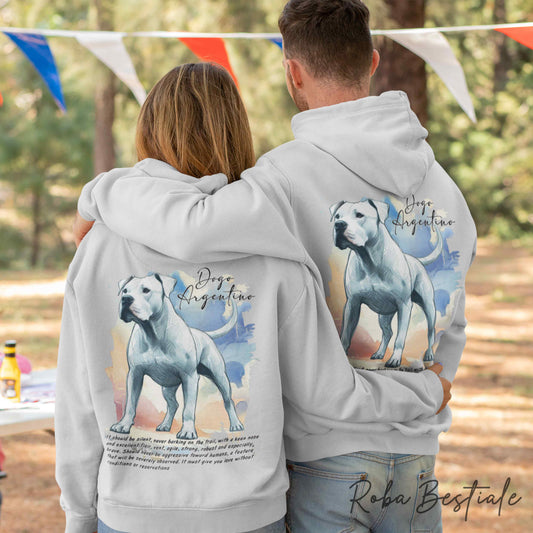
Dogo Argentino

Appronfondimenti, dettagli, curiosità sulla razza del tuo cuore

Classificazione

  • CODICE FCI

    292

  • GRUPPO

    2 - PINSCHER AND SCHNAUZER - MOLOSSOID BREEDS - SWISS MOUNTAIN AND CATTLE DOGS

  • SEZIONE

    2 - MASTIFF-TYPE DOGS

  • SOTTO SEZIONE

    2.1 Molossoid, Dogo type

L'origine del nome Dogo Argentino

The Dogo Argentino takes its name from the country in which it was bred, Argentina, and from the term "Dogo," used to describe molossoid, strong, and powerful dogs. The name therefore reflects both its geographical origin and its belonging to a type of catching dog developed for hunting and work.

  • COME CHIAMANO LA RAZZA NELLE ALTRE LINGUE

    In Italian: DOGO ARGENTINO
    In French: DOGUE ARGENTIN
    In German: ARGENTINISCHE DOGGE
    In Spanish: DOGO ARGENTINO

Cenni Storici

The creator of the breed was Dr. Antonio Nores Martínez, born in Cordoba in 1907. His work began with the methodical crossbreeding of the "Viejo Perro de Pelea Cordobés," a breed of great power and strength, produced by the then-common crossing of Bulldog and Bull-Terrier specimens. He selected totally white specimens for breeding, without prognathism, with heavy heads and long muzzles. By 1947, the breed was already created and genetically and phenotypically stable; for this reason, the breed standard was presented that same year at the "Hunters' Club" in Buenos Aires.
In 1964, it was recognized as a breed by the Argentine Canine Federation and the Argentine Rural Society, which opened the "Genealogical Register," thus beginning its registration. Recently, in 1973, it was accepted by the FCI

Cenni sullo Standard di Razza

  • Aspetto Generale

    It is an athletic, mesomorphic, normotypic dog with harmonious proportions. It has powerful muscles, is agile, and its appearance gives a sense of power, energy, and strength, in contrast to its friendly and gentle expression. Entirely white, it may have a single dark spot on its skull.

  • Andatura e Movimento

    Agile and strong, with sudden changes in showing interest towards other things, with quick reflexes, typical of the breed. Calm walk. Broad trot, with good extension of the forehand and good propulsion from the hindquarters. At a gallop, it shows all its energy and develops all its power. Its movement is agile, confident, at walk, trot or canter. It must be harmonious and measured, showing a solid build.
    Pacing is not accepted and is considered a serious fault.

  • Comportamento e Carattere

    It must be silent, no barking on the trail, with a keen sense of smell and excellent nose, quick, agile, strong, rustic and, above all, courageous.

    It must never be aggressive towards humans, a characteristic that will be severely
    assessed. It must interact with its "master" without reservations or inhibitions.

1 of 3
Un badge che identifica l'Argentina come paese d'origine di cani di diverse razze

Origine Geografica: ARGENTINA

The Dogo Argentino originated in Argentina, where the breed was developed in the province of Córdoba, in the heart of the country. This region is characterized by vast plains, forested areas, and scrubland, with a climate ranging from temperate to subtropical. In this environment, the Dogo Argentino was selected as a big-game hunting dog, capable of tackling challenging terrain and long workdays. The characteristics of the Argentine landscape thus contributed to the development of a powerful, athletic, and resilient dog, endowed with great courage and remarkable adaptability.

Dettagli Fisici

TAGLIA

Un Dogo Argentino it has a set height that goes
from 60 cm to 68 cm
for males
and from 60 cm to 65 cm
for females

The ideal height for males ranges from 64 to 65 cm
while for females it ranges from 62 to 64 cm

The approximate weight for males ranges from 40 to 45 kg
while for females it ranges from 40 to 43 kg

PROPORZIONI

Mesocephalic, the muzzle must be the same length as the skull.
The height at the withers must be slightly greater than the height at the croup.
The height at the chest must be at least fifty percent of the height at the withers. The length of the body must exceed the height at the withers by up to ten percent (no more).

  • Come si presenta

    Uniform, short, straight, with an approximate length of 1.5 to 2 cm.
    Density and thickness vary depending on the climate

  • Colori Ammessi

    • White


    Only one black, or dark, spot is permitted on the skull

  • Dettagli Sgraditi

    -Long hair
    -Total lack of pigmentation on the nose in specimens over two years of age
    -Brown nose
    -Patches of hair on the body
    -More than one spot on the head
    -Eyes of different colors or blue

  • Colori Non Ammessi

    • All other colors

Dettagli del Pelo

Entirely white. A single black or dark spot is allowed on the skull.
This spot may also be located on one of the ears or around the eyes.
The size of the spot must be appropriately proportioned, not exceeding ten percent of the size of the head. Between two specimens of the same conditions, the whiter specimen should be chosen.

Condividi:

Link copiato!